
What Can Horses Eat? Straight Answers on the Foods You’re Actually Googling
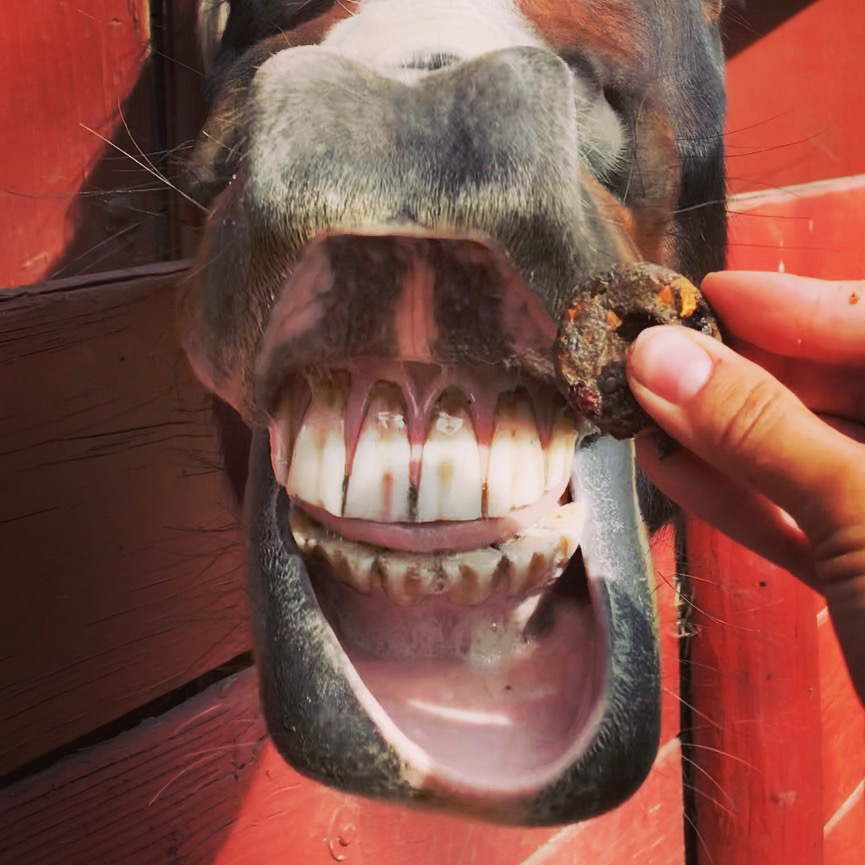
“Carrots are better and a lot cheaper.”
We hear some version of that every week, usually from someone who has just looked at the price of a bag of horse treats. For plenty of horses, she’s right. Carrots are mostly water, carry about 5 g of sugar per 100 g, and cost next to nothing at the grocery store.
The trouble starts with the search that comes next. Someone has a leftover sweet potato, a sleeve of drive-through fries on the dashboard, or the box of sugar cubes that’s lived in the tack trunk since the lesson pony retired. They type a quick question into their phone from the barn aisle, and what comes back is usually a list of safe and unsafe foods with a paragraph about moderation. That tells you what horses can eat in general and almost nothing about the horse standing in front of you.
We keep a list like that ourselves, Healthy Horse Treats: Which Are Safe and Which Are Not?, for the fruits and vegetables most horses enjoy. This article covers the five foods that list doesn’t settle. Each gets a straight answer, and then we look at what it adds to the day of a horse who has to count sugar.

What Can Horses Eat? It Depends on How the Sugar Arrives
A horse on pasture eats sugar all day. Grass stores it, and a grazing horse takes it in a mouthful at a time from morning to night. Equine nutritionist Clair Thunes calculated that a 1,200-pound horse eating 2% of body weight as dry matter from hay daily, with hay at 10% nonstructural carbohydrate (NSC) on a dry-matter basis, consumes about 1,090 grams of NSC per day. thehorse
The treat is the modern part. Small paddocks, set meals and a pocket full of peppermints replaced a slow day on grass with a few concentrated hits at the gate. For a healthy horse that hardly registers, since a sugar cube is under half a percent of that daily figure. For a horse with insulin dysregulation, EMS, PPID or a history of laminitis, how fast the sugar lands matters as much as how much there is. Keep that in mind through each answer below.
Can Horses Eat Sweet Potatoes?
Raw or cooked, yes. Despite the name, sweet potatoes and yams are vines in the morning glory family, whereas Irish potatoes are in the nightshade family, and sweet potatoes don’t carry the compounds that make raw regular potatoes unsafe. ker
What they do carry is starch. Kentucky Equine Research puts sweet potatoes at much more starch (about 12.9% vs. 2.1%, as fed) than carrots, with similar sugar and roughly double the calories. A few thumb-sized pieces make a reasonable treat for a healthy horse. The whole leftover potato from Sunday dinner is closer to a small grain meal, and a starch-sensitive horse is better off without it. ker
Can Horses Eat French Fries?
A fry snatched off a kid’s plate at a horse show won’t hurt anything, but there’s no reason to offer them. Fries come from regular potatoes, and cooked potatoes are on the avoid list for horses with insulin resistance, Cushing’s, or laminitis risk in equine nutritionist Dr. Juliet Getty’s guidance. A handful of restaurant fries is mostly starch and frying oil, with more than 40 grams of carbohydrate per 100 grams. That’s exactly the kind of dense, fast dose a grazing horse was never built to get in one bite. equisearch
Can Horses Have Brown Sugar?
Brown sugar is white sugar with a little molasses mixed back in, and it’s about 95 percent sucrose. The minerals from the molasses arrive in amounts too small to matter, and it dissolves just as quickly as white sugar. For a horse, a spoonful of brown sugar is a sugar cube in a different color, so the sugar cube answer below covers it.
Can Horses Eat Molasses?

Most horses already do, through their feed. Manufacturers use molasses to improve taste, keep dust down and hold pellets together. Depending on the source and how much water it contains, molasses runs somewhere between 35 and 60 percent sugar. That sounds alarming until you look at how much of it actually ends up in the bucket.
Most sweet feeds are less than 10 percent molasses. Say a horse gets 4 pounds a day of a feed that’s 6 percent molasses, and that molasses is about 40 percent sugar. Then the molasses contributes roughly 44 grams of sugar, about an ounce and a half. What it’s paired with changes the picture too. In Kentucky Equine Research’s trial, adding molasses to oats had little effect on glycemic response, while adding molasses to corn caused a large increase in glycemic response. kerker
Molasses gets more blame than it has earned in a healthy horse’s diet. For a metabolic horse, though, finding it on an ingredient list is a good reason to read the rest of that tag line by line. We cover the research in more depth in The Real Issue with Sugar and Molasses for Horses.
Can Horses Have Sugar Cubes?
A pure sugar cube weighing about 4 grams is 100% sucrose. Thunes considers three or four unlikely to cause a meaningful spike in a healthy horse, which fits that 1,090-gram daily number. Her advice changes for horses with uncontrolled insulin resistance, PSSM or a laminitis history: skip them. Peppermints belong in the same category, at around 70 percent sugar. thehorse
How Much Sugar in Horse Treats Is Too Much for a Sugar-Sensitive Horse?
If one sugar cube is a rounding error against a day of hay, it’s fair to ask why owners of metabolic horses guard the treat pocket so closely. The answer has less to do with any single treat than with how sugar from treats behaves.
The sugar in sugar cubes dissolves quickly and will move with the liquid fraction of the digesta, which moves more rapidly than larger fibrous particles. It’s absorbed well ahead of the sugar bound up in hay fiber. A horse whose body already overreacts to sugar with a surge of insulin gets that surge sooner. thehorse
Repetition seems to matter too, though the evidence is early. In a 2022 Queensland University of Technology study, ten ponies, four of them insulin dysregulated, got one or two slices of applesauce-coated bread twice a day for ten days. Their blood insulin didn’t change, but their guts did. Afterward the ponies absorbed simple sugar about 1.6 times more readily, and post-meal GLP-2, an intestinal hormone that stimulates insulin release, was 1.4 times higher. Nobody has tested what happens over months, so this is a finding to watch, not a reason to panic. thehorse

Then there’s simple addition. A typical 200 g apple contains roughly 20 g of sugar, and a three-piece serving (about 15 grams) contains 8 to 10 grams of sugar for round peppermints. Picture a day when the farrier comes, the grandkids visit and the horse finally loads on the first try. It’s easy to hand out four or five of each without noticing. On top of hay that may already sit close to your horse’s limit, that’s how a carefully built diet drifts. horse-canadathehorse
For a metabolic horse, the useful number is ESC plus starch across the whole diet. Around 10 percent is a commonly used target, and your vet is the right person to set it for your horse. Treats are the input most owners never measure, and also the easiest one to measure. Put one typical handful on a kitchen scale, once, and multiply by however many go out on a normal day. Then add that figure to the rest of the ration in our Diet & NSC Calculator to see the full total.
What Are the Best Treats for Horses Who Count Sugar?
Owners of metabolic horses rarely want to give up treats entirely, and they don’t have to. The best treat for that horse is one whose sugar and starch you already know, made without grain or molasses bulking it up.
Which brings us back to price, because “a lot cheaper” deserves a real answer. Most commercial treats get inexpensive the same way most feeds do. Grain, molasses and byproducts are cheap to buy and easy to bind, and they happen to be the ingredients a metabolic horse can least afford. Leave them out, and every ingredient left in the bag has to be worth its cost.
That’s how we make our Super Food Horse Treats. They have eight human food grade ingredients, made in small batches in California: chia, hemp seeds, dandelion leaf, carrots, rosehips, coconut oil, a pinch of cinnamon and boiled apple cider. There’s no grain, corn, soy, molasses, GMOs, fillers or byproducts.
They come in two versions, with sugar and starch listed separately for each. The Low Sugar treats test at ESC 11.4% Starch 1.8%. The Extra Low Sugar version, made for horses on sugar-restricted diets, has undergone independent nutritional testing by Equi-Analytical. Its low-glycemic formulation also considers how different carbohydrates affect insulin response, not just their total percentages.

In sugar-cube terms, it would take about 65 grams of the Extra Low Sugar treats to equal the sugar in one 4-gram cube. Rich in beneficial fats from chia, hemp seeds, and coconut oil, these treats are designed to be enjoyed in moderation, just like any treat. One customer told us what she values most is knowing she’s handing over “a treat that is actually good for my horse.”
Back at the Fence
Carrots really are a good treat, and still the cheapest one at the barn. For a healthy horse, a piece of sweet potato or the occasional sugar cube belongs in the same easy category. For a sugar-sensitive horse, each of those choices adds to a total someone is already watching, and what the extra money buys is a treat whose numbers you never have to guess.
One owner told us her metabolic mare gets a “cookie” with her eye medication every day. She found one she trusted and stopped second-guessing: “this is the only one I’ll give her.” That’s the place to get to. You know what your horse can handle and roughly what the day adds up to. The next time someone at the barn asks whether your horse can have a bite of their fries, you’ll already have the answer.
Next read: If the biggest sugar number in your horse’s day turns out to be the hay, Is This Year’s Hay Sweeter? Finding Low NSC Hay for Metabolic Horses in a Drought Year picks up from here.
References
Thunes, C., “Sugars and Peppermints: Not Safe Treats for All Horses,” TheHorse.com, December 24, 2024 (1,090 g daily NSC example, 4 g sugar cube, peppermint sugar, rapid absorption, horses that should avoid sugary treats)
Kentucky Equine Research, “Sweet Potatoes for Horses” (morning glory vs. nightshade families, 12.9% vs. 2.1% starch, calories, raw or cooked in small amounts)
Getty, J., “Dr. Getty’s Tip on Treats: Which Are Safe and Which Are Not?,” EquiSearch, December 28, 2011 (cooked potatoes and molasses treats on the avoid list for IR and Cushing’s horses)
USDA FoodData Central, McDonald’s french fries (FDC 170721)
USDA FoodData Central, Sugars, brown (sucrose content)
Mad Barn FeedBank, Molasses entries (sugar content range by source and dry matter)
Kentucky Equine Research, “Using Molasses in Horse Feeds” (glycemic response to molasses with oats vs. corn)
Sibthorpe, P.E.M., Fitzgerald, D.M., Chen, L., Sillence, M.N., and de Laat, M.A., “A Starch-Rich Treat Affects Enteroinsular Responses in Ponies,” Journal of the American Veterinary Medical Association, 260(S3), S94–S101, 2022 (10 ponies, 1.6-fold sugar absorption, 1.4-fold GLP-2, no change in blood insulin)
Pratt-Phillips, S., “Expert Tips for Feeding Insulin Resistant Horses,” Horse Canada, January 28, 2020 (sugar per 100 g in carrots and apples)
Twenty Four Carrots, Super Food Horse Treats product page (ingredients, Low Sugar and Extra Low Sugar ESC and starch, crude fat)


Comments